
- Posted on
It was six-thirty in the evening of the first day of November of the year 2032, the air conditioner roared like a stubborn beast, refusing to acknowledge the cold weather outside. Its refrigerated air poured relentlessly over Vyjayanti Kshir, slipping under her collar and past every layer of cloth to settle, sharp and uninvited, deep into her bones.
She was the CEO, or as everyone called her in the company ‘Beni’, of Ankhya systems and machinery. Along with a young engineer Rishi Uttam, she sat outside the doors of the ministry of defence, waiting for their names to be called.
Rishi couldn’t help but fidget with anticipation, his eyes fixed on the entrance doors. Although he was a brilliant engineer and had done many presentations in his nascent career, this was the first time he would be presenting to someone this important.
Vyjayanti patted him on the back. “It’s going to be alright Rishi…” she said in a calm voice and a smile on her face adding “… just like we practiced…” her tone soothing.
She had been waiting for this moment for what felt like an eternity. She knew that the real reason for Rishi’s carefully crafted presentation wasn’t its merits as a proposal in itself, but rather as a Trojan horse, a means to an end. By packaging it as a viable idea, she hoped to slip past the ministry’s defences and into a meeting where she could ask them just one question. An important question. One that her father had wanted to ask but couldn’t. An entire generation just to ask one question.
Vyjayanti was everything Rishi needed in a boss. Even though she was just a couple of inches taller than an average woman, at fifty-three, she still carried herself with poise and dignity. Her skin a warm, golden undertone, a testament to her Kashmiri Indian heritage. Her dark hair had begun to gray subtly, framing her face with wisps of silver that spoke to her age and wisdom.
Though her presence was unassuming, there was an aura about her that commanded respect. A sense of quiet authority, earned not through loud declarations but through years of listening, observing, and absorbing the world around her, so that when she finally spoke, her words carried weight, gravity, and a depth of meaning that few others could match.
The presentation began a few minutes later, in the secure conference room of the ministry, to an audience of bureaucrats and senior members of the Indian Navy. Rishi ran through the proposal as planned and practiced before, explaining technical details with ease. Vyjayanti was quiet, absorbing everything around her.
The minister, for his part, seemed to tolerate the technical portion, and only leaned forward and watched with intent, when it came to the matter of the costs that Ankhya systems and machinery proposed. The minister’s expression turned grave as he processed the numbers on the slide before him. These costs were indeed above what they had anticipated; an extra twenty percent on top of the already staggering maintenance budget. He let out a deep sigh, his eyes meeting those of Vyjayanti and Rishi in turn. “How can we justify these expenses?” he asked bluntly. “Look, I think you very well know that you are just one of two companies that has proposed a solution. And to be quite honest, it feels like the both of you are out to fleece the taxpayer… like a cartel.” He scowled.
Vyjayanti’s expression remained steady. Rishi was the one to answer. “Sir, our team has worked tirelessly to develop our personnel shielding system, which I must say, is vital in reducing the risk of radiation leakage from the reactors. Most of our costs goes into this shielding.”
“Hmm,” said the minister, his face still a glower from looking at the costs. “It’s a conspiracy I tell you…” he added, still not convinced. He then turned back to face the Navy staff and asked, “What do you all think?” All he got in return for an answer from them was a tepid agreement and not a unanimous one that he was hoping. “Tch…” he voiced.
It was now or never for Vyjayanthi. The trigger had been primed.
“We can do this for you… completely free of cost. We’ll absorb all the costs.” She said, speaking for the first time since the proposal began, her voice not betraying anything under. She felt the glare of Rishi on her temple. He didn’t know she was going to do this.
“Ma’am…” he began.
Vyjayanti held out her palm, requesting him to be silent. All Rishi could do was oblige.
The minister, a man with an intelligent face, but with a body that spoke to his love of carb-rich diet leaned back in his chair at the unexpected offer. There had to be a catch. There was always a catch.
“What… forever… you will do this for us free for ever?” he asked with his eyebrows high, steepling his fingers.
“Let’s say… seven years. I do this free for seven years.” She replied.
The minister sighed deeply and asked “So… what’s the catch? What do you want in return?”
Vyjayanti took a deep breath. “I want access to what you have in Konark.”
“Konark… what do we have in Konark?” asked the minister curiously.
“I want access to the tech you have in Konark.”
“What tech?” asked the minister, his eyes furrowed in concern. “You mean access to the DRDO facility? Why would you want that? You have no business there. There is no need to ask for all of that.” He added. He closed the proposal file with a thump, signalling the end of the meeting. “We’ll review your proposal and let you know in fifteen days. The taxpayers don’t need your charity. Thank you so much.” He said, wanting to abruptly stop the conversation that Vyjayanti had started.
Then slowly and deliberately, Vyjayanti said the names, “Shankari, Somaara, Trika, Haarati, Martanda, Nilamata, Ananta.” She said the names, only those names, and nothing else.
The irritation in the minister’s face vanished immediately. It turned to one of surprise. Everyone in the room could see he understood the significance of those names… said in that specific order.
His voice had become a tremble now. “Everyone out of the room please…” he requested, then turned to the chief of the Indian Navy, whose face was also one of surprise, and said, “You stay back.”
Vyjayanti turned to Rishi and nodded, signalling him to leave. All he could do was follow her orders, yet his mind kept wandering back to what had just transpired. He left without question, hoping that she would tell him later.
When the doors of the rooms squeezed shut, the minister walked to it and gave it a tug to ensure it was indeed locked. He hadn’t taken his eyes of Vyjayanti the entire time. When he sat back down, he asked, “How do you know those names?”
Vyjayanti relaxed a bit with a deep sigh. “You should have run the background checks with my original name. My birth name. Vyjayanti Bhairav. Then you would have learned that I am the great-granddaughter of Kechar Bhairav.” She said and then asked, “Do you know who Kechar Bhairav is?”
“He brought them to Konark from Kashmir, didn’t he?” the minister asked.
“Yes. The ones that Raja Hari Singh handed over to India. Yes, he did.” Vyjayanti said. Then with her voice almost apologetic she added “I know men like my great-grandfather had to take secrets like this to their funeral-pyre, but in his last days, I and my father happened to be near him. That’s when he spilled all the secrets. I can assure you, sir, that outside of this room, no one knows. We’ll take it to our own end. All I want is access to the tech.”
There was silence in the room, for quite a while, as the minister considered the request. It was the chief of the Indian Navy who then asked, “Subrahmanyan Chandrasekhar couldn’t crack the technology. How do you expect to crack it if he could not?”
“I don’t want the spacecraft, Sir. I know it’s broken. Perhaps even degraded beyond repair,” Vyjayanti said, then added “I want the beings. I know they are artificial beings… manufactured… perhaps to cross the vast distances across space and time. I want them.”
“What will you do with them?” asked the minister.
“I want the computing paradigm that ran them. Digital computing… for lack of better words… has run its course…”
The minister’s eyes narrowed, a hint of curiosity flickering in their depths as they leaned forward, voice low and measured. “People before you have tried to unlock their secrets, Vyjayanti. They haven’t been successful. But all of them… and I mean all of them, across generations, have said one thing. That this is a dangerous idea.”
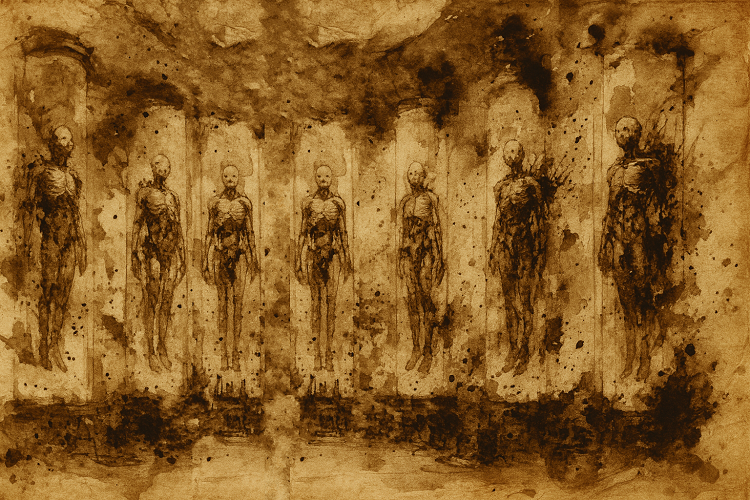
He paused, his gaze drifting away from her, as if pondering the weight of his own words. “The seven artificial beings,” he continued, his voice barely above a whisper. “I’ve seen them with my own eyes. Nothing in the world… even today… matches the technology they possess.”
His eyes snapped back to hers, and for an instant, Vyjayanti thought she saw something there; a glimmer of understanding that threatened to upend everything. But then, in the blink of an eye, it was gone. The minister’s expression smoothed into its usual mask of detachment.
“Very well,” he said and without any hint of importance, “I’ll grant you access to... the seven. Let’s see if you have any luck with it.”
Vyjayanti felt a shiver run down her spine as she processed his answer.
But before she could fully process it, the minister added with a chuckle “… and don’t forget your promise. Seven years, free of charge. I’ll send you the contract papers soon.”
And then, without another word, the minister and the chief of the Indian Navy stood up, and walked out of the room, leaving Vyjayanti alone.
As the door closed behind the minister, Vyjayanthi felt the air thicken around her, like the moment before a storm breaks.
She remembered the last words of her great-grandfather. For the longest time she thought it was said in delirium.
“I’ve seen the Devas. They are as beautiful as the stories say. They don’t decay even in death. Remember their names, Vyjayanthi. Remember their names. Shankari, Somaara, Trika, Haarati, Martanda, Nilamata, Ananta.”
Note from the Author : The story you just read is a prequel to 'Exodus', a short story in my published science fiction anthology titled 'LIM : At the limits of reality'. In Exodus, we witness the dawn of a new computing paradigm. A dire necessity, its mother. These advanced machines, exhibiting unprecedented levels of self-awareness and sentience, challenge the very definition of humanity, forcing us to consider the implications.
The book is available for sale on Amazon here. https://www.amazon.in/dp/819936548X .