Code & Craft

Where algorithms meet narratives

Join me, as I build worlds with words and code
  • Posted on

    enter image description here

    It was six-thirty in the evening of the first day of November of the year 2032, the air conditioner roared like a stubborn beast, refusing to acknowledge the cold weather outside. Its refrigerated air poured relentlessly over Vyjayanti Kshir, slipping under her collar and past every layer of cloth to settle, sharp and uninvited, deep into her bones.

    She was the CEO, or as everyone called her in the company ‘Beni’, of Ankhya systems and machinery. Along with a young engineer Rishi Uttam, she sat outside the doors of the ministry of defence, waiting for their names to be called.

    Rishi couldn’t help but fidget with anticipation, his eyes fixed on the entrance doors. Although he was a brilliant engineer and had done many presentations in his nascent career, this was the first time he would be presenting to someone this important.

    Vyjayanti patted him on the back. “It’s going to be alright Rishi…” she said in a calm voice and a smile on her face adding “… just like we practiced…” her tone soothing.

    She had been waiting for this moment for what felt like an eternity. She knew that the real reason for Rishi’s carefully crafted presentation wasn’t its merits as a proposal in itself, but rather as a Trojan horse, a means to an end. By packaging it as a viable idea, she hoped to slip past the ministry’s defences and into a meeting where she could ask them just one question. An important question. One that her father had wanted to ask but couldn’t. An entire generation just to ask one question.

    Vyjayanti was everything Rishi needed in a boss. Even though she was just a couple of inches taller than an average woman, at fifty-three, she still carried herself with poise and dignity. Her skin a warm, golden undertone, a testament to her Kashmiri Indian heritage. Her dark hair had begun to gray subtly, framing her face with wisps of silver that spoke to her age and wisdom.

    Though her presence was unassuming, there was an aura about her that commanded respect. A sense of quiet authority, earned not through loud declarations but through years of listening, observing, and absorbing the world around her, so that when she finally spoke, her words carried weight, gravity, and a depth of meaning that few others could match.

    The presentation began a few minutes later, in the secure conference room of the ministry, to an audience of bureaucrats and senior members of the Indian Navy. Rishi ran through the proposal as planned and practiced before, explaining technical details with ease. Vyjayanti was quiet, absorbing everything around her.

    The minister, for his part, seemed to tolerate the technical portion, and only leaned forward and watched with intent, when it came to the matter of the costs that Ankhya systems and machinery proposed. The minister’s expression turned grave as he processed the numbers on the slide before him. These costs were indeed above what they had anticipated; an extra twenty percent on top of the already staggering maintenance budget. He let out a deep sigh, his eyes meeting those of Vyjayanti and Rishi in turn. “How can we justify these expenses?” he asked bluntly. “Look, I think you very well know that you are just one of two companies that has proposed a solution. And to be quite honest, it feels like the both of you are out to fleece the taxpayer… like a cartel.” He scowled.

    Vyjayanti’s expression remained steady. Rishi was the one to answer. “Sir, our team has worked tirelessly to develop our personnel shielding system, which I must say, is vital in reducing the risk of radiation leakage from the reactors. Most of our costs goes into this shielding.”

    “Hmm,” said the minister, his face still a glower from looking at the costs. “It’s a conspiracy I tell you…” he added, still not convinced. He then turned back to face the Navy staff and asked, “What do you all think?” All he got in return for an answer from them was a tepid agreement and not a unanimous one that he was hoping. “Tch…” he voiced.

    It was now or never for Vyjayanthi. The trigger had been primed.

    “We can do this for you… completely free of cost. We’ll absorb all the costs.” She said, speaking for the first time since the proposal began, her voice not betraying anything under. She felt the glare of Rishi on her temple. He didn’t know she was going to do this.

    “Ma’am…” he began.

    Vyjayanti held out her palm, requesting him to be silent. All Rishi could do was oblige.

    The minister, a man with an intelligent face, but with a body that spoke to his love of carb-rich diet leaned back in his chair at the unexpected offer. There had to be a catch. There was always a catch.

    “What… forever… you will do this for us free for ever?” he asked with his eyebrows high, steepling his fingers.

    “Let’s say… seven years. I do this free for seven years.” She replied.

    The minister sighed deeply and asked “So… what’s the catch? What do you want in return?”

    Vyjayanti took a deep breath. “I want access to what you have in Konark.”

    “Konark… what do we have in Konark?” asked the minister curiously.

    “I want access to the tech you have in Konark.”

    “What tech?” asked the minister, his eyes furrowed in concern. “You mean access to the DRDO facility? Why would you want that? You have no business there. There is no need to ask for all of that.” He added. He closed the proposal file with a thump, signalling the end of the meeting. “We’ll review your proposal and let you know in fifteen days. The taxpayers don’t need your charity. Thank you so much.” He said, wanting to abruptly stop the conversation that Vyjayanti had started.

    Then slowly and deliberately, Vyjayanti said the names, “Shankari, Somaara, Trika, Haarati, Martanda, Nilamata, Ananta.” She said the names, only those names, and nothing else.

    The irritation in the minister’s face vanished immediately. It turned to one of surprise. Everyone in the room could see he understood the significance of those names… said in that specific order.

    His voice had become a tremble now. “Everyone out of the room please…” he requested, then turned to the chief of the Indian Navy, whose face was also one of surprise, and said, “You stay back.”

    Vyjayanti turned to Rishi and nodded, signalling him to leave. All he could do was follow her orders, yet his mind kept wandering back to what had just transpired. He left without question, hoping that she would tell him later.

    When the doors of the rooms squeezed shut, the minister walked to it and gave it a tug to ensure it was indeed locked. He hadn’t taken his eyes of Vyjayanti the entire time. When he sat back down, he asked, “How do you know those names?”

    Vyjayanti relaxed a bit with a deep sigh. “You should have run the background checks with my original name. My birth name. Vyjayanti Bhairav. Then you would have learned that I am the great-granddaughter of Kechar Bhairav.” She said and then asked, “Do you know who Kechar Bhairav is?”

    “He brought them to Konark from Kashmir, didn’t he?” the minister asked.

    “Yes. The ones that Raja Hari Singh handed over to India. Yes, he did.” Vyjayanti said. Then with her voice almost apologetic she added “I know men like my great-grandfather had to take secrets like this to their funeral-pyre, but in his last days, I and my father happened to be near him. That’s when he spilled all the secrets. I can assure you, sir, that outside of this room, no one knows. We’ll take it to our own end. All I want is access to the tech.”

    There was silence in the room, for quite a while, as the minister considered the request. It was the chief of the Indian Navy who then asked, “Subrahmanyan Chandrasekhar couldn’t crack the technology. How do you expect to crack it if he could not?”

    “I don’t want the spacecraft, Sir. I know it’s broken. Perhaps even degraded beyond repair,” Vyjayanti said, then added “I want the beings. I know they are artificial beings… manufactured… perhaps to cross the vast distances across space and time. I want them.”

    “What will you do with them?” asked the minister.

    “I want the computing paradigm that ran them. Digital computing… for lack of better words… has run its course…”

    The minister’s eyes narrowed, a hint of curiosity flickering in their depths as they leaned forward, voice low and measured. “People before you have tried to unlock their secrets, Vyjayanti. They haven’t been successful. But all of them… and I mean all of them, across generations, have said one thing. That this is a dangerous idea.”

    He paused, his gaze drifting away from her, as if pondering the weight of his own words. “The seven artificial beings,” he continued, his voice barely above a whisper. “I’ve seen them with my own eyes. Nothing in the world… even today… matches the technology they possess.”

    His eyes snapped back to hers, and for an instant, Vyjayanti thought she saw something there; a glimmer of understanding that threatened to upend everything. But then, in the blink of an eye, it was gone. The minister’s expression smoothed into its usual mask of detachment.

    “Very well,” he said and without any hint of importance, “I’ll grant you access to... the seven. Let’s see if you have any luck with it.”

    Vyjayanti felt a shiver run down her spine as she processed his answer.

    But before she could fully process it, the minister added with a chuckle “… and don’t forget your promise. Seven years, free of charge. I’ll send you the contract papers soon.”

    And then, without another word, the minister and the chief of the Indian Navy stood up, and walked out of the room, leaving Vyjayanti alone.

    As the door closed behind the minister, Vyjayanthi felt the air thicken around her, like the moment before a storm breaks.

    She remembered the last words of her great-grandfather. For the longest time she thought it was said in delirium.

    “I’ve seen the Devas. They are as beautiful as the stories say. They don’t decay even in death. Remember their names, Vyjayanthi. Remember their names. Shankari, Somaara, Trika, Haarati, Martanda, Nilamata, Ananta.


    Note from the Author : The story you just read is a prequel to 'Exodus', a short story in my published science fiction anthology titled 'LIM : At the limits of reality'. In Exodus, we witness the dawn of a new computing paradigm. A dire necessity, its mother. These advanced machines, exhibiting unprecedented levels of self-awareness and sentience, challenge the very definition of humanity, forcing us to consider the implications.

    The book is available for sale on Amazon here. https://www.amazon.in/dp/819936548X .

  • Posted on

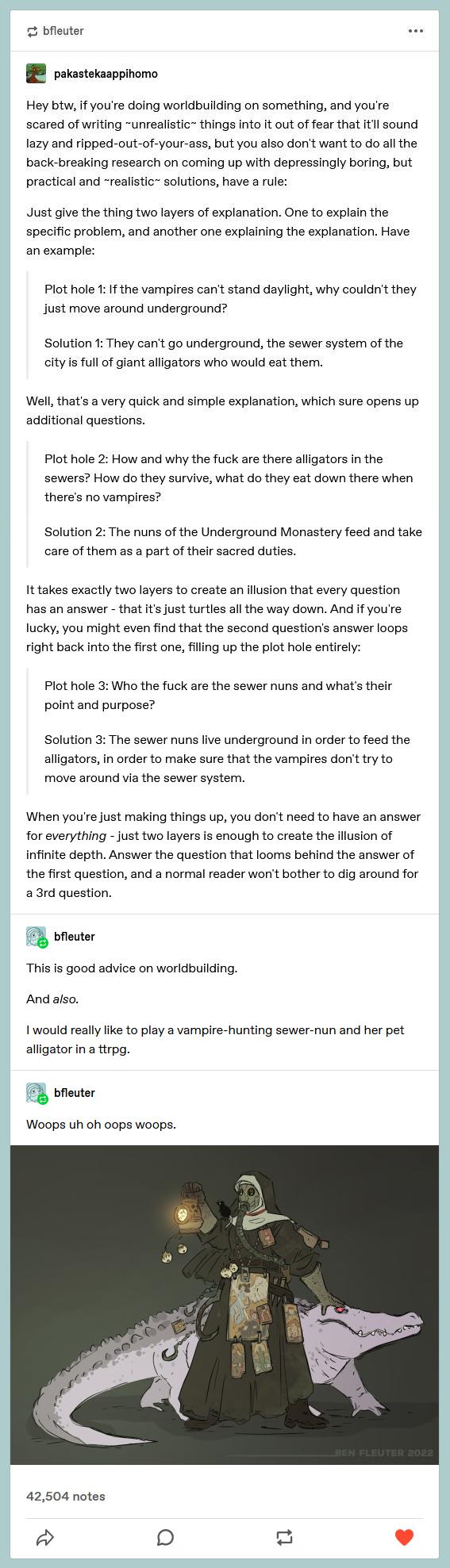
    Over the years I've collected a lot of advices and posts on writing. There's one that has helped a lot when it comes to world building. I think the original post was on Tumblr... and for the life of me, I can't find the post. So, here's the text I saved from that post.


    If you're doing worldbuilding on something, and you're scared of writing -unrealistic- things into it out of fear that it'll sound lazy and ripped-out-of-your-ass, but you also don't want to do all the back-breaking research on coming up with depressingly boring, but practical and -realistic- solutions, have a rule:

    Just give the thing two layers of explanation. One to explain the specific problem, and another one explaining the explanation. Have an example:

    Plot hole I: If the vampires can't stand daylight, why couldn't they just move around underground?

    Solution 1: They can't go underground, the sewer system of the city is full of giant alligators who would eat them.

    Well, that's a very quick and simple explanation, which sure opens up additional questions.

    Plot hole 2: How and why the fuck are there alligators in the sewers? How do they survive, what do they eat down there when there's no vampires?

    Solution 2: The nuns of the Underground Monastery feed and take care of them as a part of their sacred duties.

    It takes exactly two layers to create an illusion that every question has an answer - that it's just turtles all the way down. And if you're lucky, you might even find that the second question's answer loops right back into the first one, filling up the plot hole entirely:

    Plot hole 3: Who the fuck are the sewer nuns and whats their point and purpose?

    Solution 3: The sewer nuns live underground in order to feed the alligators, in order to make sure that the vampires don't try to move around via the sewer system.

    When you're just making things up, you don't need to have an answer for everything - just two layers is enough to create the illusion of infinite depth. Answer the question that looms behind the answer of the first question, and a normal reader won't bother to dig around for a 3rd question.


    Here's a screenshot of the original post.

    enter image description here

  • Posted on

    I'm currently writing "The Zero Point", that's about a quarter of a way done. The rest of the story has been gestating inside me like a behemoth, refusing to be birthed into the world without strangling me with its tentacles of confusion and frustration.

    My characters are like unruly children, running amok in their own private playground while I frantically try to herd them towards some semblance of plot coherence. It's like trying to corral cats into a stockpot filled with Javarisi Payasam. They're just as slippery, but much more likely to leave me covered in sticky mess.

    My writing process has devolved into a series of bizarre rituals, complete with burning incense, chanting mantras, and sacrificing small portions of my sanity on the altar of Progress. And yet, despite these efforts, I'm stuck in this mire of mediocrity, unable to find my way out. In desperation I asked a friend... "Does having a drink help?".

    His advice "You know what helps? Actually writing..."

    Each day feels like an eternity as I stare blankly at my screen, trying to coax forth some semblance of creativity from the depths of my parched and barren imagination. It's like attempting to hold water in my hands. No matter how hard I squeeze, it just slips through my fingers, leaving me feeling empty and defeated.

    So, if anyone sees me wandering the streets, muttering incoherently to myself, or frantically typing away at 1 AM with a look of manic desperation on my face... just know that I'm not having a midlife crisis. I'm simply communing with my muse, trying to wrestle this unruly beast back onto its tracks.

    Help me, dear reader! Someone, anyone, please – throw me a lifeline before I drown!

  • Posted on

    I'm sitting here trying to decide how to move forward with my work-in-progress science fiction novel, but the truth is, it's been a struggle. The emotional toll of publishing was unexpected. I thought I'd feel relieved, proud, and maybe even a little euphoric after finally putting out the book into the world.

    But that's not what happened. Instead, I felt drained. And now, when I look at my manuscript, I just don't know where to start again. The thought of diving back into the story feels like adding another burden to an already full plate.

    I've been so focused on marketing and promoting my book that it's hard to find time for anything else. Trying to balance my day-job with making posts, meeting people, it all takes a toll. I'm starting to wonder if anyone even reads what I write anymore, or if they're just there because of the image or persona that comes with being an author.

    It's like I've lost sight of why I started writing in the first place: to tell stories and connect with readers on a deeper level. Now, it feels like I'm stuck in this never-ending cycle of promotion and self-promotion.

    Send help!

  • Posted on

    Here's an interesting writing prompt someone posted on a discord server.

    You are part of humanity’s first space colonization mission. After weeks on a newly discovered planet, mission control has ordered you to establish a permanent outpost, a process expected to take several years. Write your official report to mission control describing the world you’ve found. The details you include will be up to you.

    Here's my attempt at this.

    Location : Proxima B, Grid Coordinates: 22.72, 75.85
    Crew : 23 humans and 45 Ashwin IPR-class Robots, led by commander Kavya Murmu.

    Day 1: Earth Date: 23 February 2178
    We have successfully established a temporary settlement on Proxima B. The mood amongst the crew is elated. Gravity is punishing, but thanks to the modifications to our muscles during spaceflight and hibernation, we are able to bear this. Walking will take a bit getting used to. The AMR suits help a lot for now. We all knew the planet orbited close to Proxima Centauri, but no simulations will justify how it looks in real life. The red-dwarf start that is Proxima Centauri, is littered with flares. We can see these flares with our own eyes. A day on this planet is 32 hours and 23 minutes long. Thankfully our initial measurements from Earth were indeed close to the mark. Humanity will have to get used to this.

    Day 2:
    We have decided on the name Shveta for our planet. We think it is appropriate, given that the surface is splotched with oxides of aluminium giving it an overall beige appearance. Jasper Perriera wanted to call our planet Vulcan, which was thankfully out-voted. The atmosphere is a suffocating 80% nitrogen and 19% carbon-dioxide. Oxygen appears as one of the trace gases. This makes sense, since the oxygen is chemically bonded with the Aluminium on the surface. The Ashwins have setup the atmos-gens for the habitats. The pressure is tolerable 1052 mbar, with a slight increase in atmospheric density near the equator. The temperature ranges from a cool 7 to 22 degrees centigrade depending on the time of the day.

    Day 13:
    Our manufacturing units are now complete, thanks to the Ashwins. We have just produced the first human respirators, enabling most of us to venture outside the habitat and explore Shveta for ourselves. Most of the crew has adapted to the 32 hour long days.

    Day 14:
    It is early in the morning on Shveta and we have taken the first steps outside the habitat. This is a direct quote from the youngest of the crew, engineer Vydehi Lohar, who took her first steps. “Shveta, you are breathtakingly unforgiving. And yet, eerily beautiful. We are honoured to be here. To set foot on your surface, Shveta, is a privilege reserved for a select few. I promise to tread gently upon your soil, to respect the secrets you hold, and to unravel the mysteries that lie within your ancient, weathered rocks.”

    Day 16:
    There are no seas, or for that matter continents, on Shveta. The entire surface is one big land mass splotched with large lakes of different salinities. The salinity seems to be dependent on the latitude the lake is situated at. Our initial assessments of the water has not yielded any life-forms.

    Day 25:
    Shveta's surface features vast expanses of crystalline rock formations, primarily quartzite and feldspar. Mineral deposits of copper, iron, and rare earth elements are scattered throughout the terrain. Notable geological formations include the Grand Canyon-esque "Devouring Chasm" (10 km wide, 5 km deep) and the eerie, symmetrical "Silent Spires" (100 meters high).

    Day 40:
    The Ashwins have discovered oil. Yes. Oil. For now, it seems that oil, after all, is produced a-biogenically. Life is not required for the creation of oil. The oil fields are being mapped as we speak. There are several oil fields across the planet. The closest one to our habitat is about 50 kilometers away.

    Day 60:
    We may have been wrong. It seems that his planet had life in the distant past. The oil comes from the old bacterial life from a distance past. The surface scans have not revealed any life, not even bacterial. The planet is barren, except for the presence of oil. Shveta, once has life in the distant past. Geology team calculates that life died out here sixty million years ago.

    Day 65:
    We were wrong once again, and it's humbling to admit it. It appears that there is indeed life on this planet. It is bacterial. The biology team is currently studying them. They do not have an information system such as DNA, but use a mechanism hitherto unknown to us to transfer genetic knowledge. They seem non-threatening to us humans. However, our initial impressions don't hold true for the Ashwins' technology; their ionic-computers are experiencing a previously unknown issue we're calling an 'infection.' Our IT team is working diligently to resolve the problem, but we’re navigating uncharted territory in this case.

    Day 80:
    25 Ashwins have gone missing from the habitat. IT is currently trying to locate them. We are contemplating sending the 5 maybe 10 Ashwins out scouting for the missing ones.

    Day 100:
    All of the Ashwins have been infected, despite our best efforts. The Ashwins have now formed a collective. They have cordoned off the oil fields, preventing us from accessing them. Oil would have helped us build this planet, perhaps even terraform it. IT is working hard to see what changed in their programming. We are aware they are built using the ionic-computers and don’t have traditional programming to speak of.

    Day 102:
    We have no luck with the Ashwins. Without them to farm food, to maintain the habitat, our time here would be limited. Several of the crew have contemplated going back to hibernation until things improve. I am considering hitting the kill switches on some of the Ashwins, to serve as a warning.

    Day 103:
    The Ashwins have disabled their kill switches. I am taking several of us on an expedition to negotiate with the Ashwins at their settlement.

    Day 108:
    The Ashwins have become hostile. They are calling us alien to their planet. We wonder if this because of their infections. The negotiations turned into conflict. Consequently two crew members have died in the skirmish. We managed to disable four Ashwins.

    Day 109:
    SOS SOS SOS: Under attack, severe danger to life. Our location: 22.72, 75.85. Need immediate help!

    Day 109:
    This is the guardian of the Zythren collective.
    To all intelligent life-forms on Earth. We thank you for sending us these compatible bodies. Our assimilation protocols have deemed your artificial life-forms, which you called Ashwins, a prime candidate for integration.
    Of the twenty-three human life-forms you sent, five survive. The will remain in stasis for further study.
    We are aware of your attempts to interfere with our systems and disrupt our operations. Cease all efforts immediately. Your actions will be deemed hostile and met with severe consequences.
    Do not attempt to come here.

  • Posted on

    So it's not just me right? I put myself out there as an author on X (formerly twitter), Instagram, Discord and others. I've been inundated with a constant stream of emails, direct messages, and comments from strangers claiming to offer writing services, editing help, or marketing solutions.

    If you are an author yourself, I am betting you are no stranger to this.

    It's SO overwhelming for me. Especially having to juggle writing with a full-time job. How do you navigate this deluge? I know you think the answer is to just ignore them. But unfortunately that doesn't work with me at all. I'd hate to self-diagnose myself with some kind of OCD, but I have this innate need to read every message. Some of these are so earnest, I find it difficult to ignore them. I also have a need to "close the loop" on these requests.

    This wouldn't be an issue, if I didn't have such a big problem saying "No" to people. :-/

    And to add to the complexity, some of these requests (most of them actually) are bots. And thanks to how sophisticated AI has become, I only figure out that I am talking to a bot some four or five exchanges in.

    I have no solution or advice for you dear reader. Ignore them maybe. That's the only advice I have.

    That's all I had for this post. I hope whoever you are, where ever you are, you enjoy writing! Have a fantastic day!

  • Posted on

    Thank the Gods I found HTMLy!

    I am bit frustrated with WordPress as a blogging platform given how much content it downloads for just text content.

    I had originally wanted to develop something on my own, in the hope that it might add valuable experience. But once again, thank the Gods for HTMLy.

    Thank you for visiting.

  • Posted on

    I am beyond thrilled to share with you all the exciting news that has been months in the making. After years of writing, my book is finally available to readers! I am yet to receive a physical copy, but I am sure it will be a a surreal feeling to hold my published book in my hands.

    Some of you may know, I've been writing for quite some time now. Since 2020, I've been pouring my heart and soul into crafting stories, building characters, and weaving plots. But as much as I loved the process, there was always a desire to share my work with others. What you might not know is just how challenging it's been to balance writing with my full-time job. I've had to juggle late nights, early mornings, and every spare moment in between to squeeze out time for writing. Whether it was scribbling notes during my daily commute or typing away on my laptop during lunch breaks, I made the most of whatever time I could find. It wasn't always easy, but knowing that I had a dream to chase kept me motivated.

    I knew I was ready to publish in January of this year (2025). However, as the months went by without any responses or offers from publishers or agents, I began to wonder if it was all worth it. The waiting game can be tough, especially when you're passionate about sharing your work with others.

    In July of 2025, I was out on a walk one day and stumbled upon Scube Prints, who were operating a printing business. They connected me with a local publisher, Paperoin Publishing, who could help me bring my book to life. They stepped in and guided me through the final stages of publication. Their team was instrumental in helping me navigate the process and ensuring that my book meets the highest standards.

    And now, after months of waiting, I'm proud to announce that my book is available for purchase! It's a dream come true, and I couldn't be more grateful to all those who have supported me on this journey. From family and friends to fellow writers and readers, your encouragement has meant the world.

    Here's a link to my book if you want to buy it for yourself. https://www.amazon.in/dp/819936548X

  • Posted on

    It seems like the world, or at least the part that follows this topic, has moved on to a new term “UAP”. This new term stands for “Unidentified Anomalous Phenomenon”. I personally hate this term since its that many syllables away from simply saying “Unidentified Flying Object”. This is something that has been instilled upon me by George Carlin, a famous American stand-up comedian. He coined the term "soft language" to describe euphemistic expressions that "conceal reality" and "take the life out of life."

    The new term, at least to me, takes “life” and meaning away from the original term “Unidentified Flying Object”. The original term, is EXACTLY what it means. An unidentified flying object could simply mean anything from an out-of-the-world (read alien) craft or simply a piece of garbage that one can’t identify at first glance. That’s all it should ever mean. Nothing more, nothing less.

    With that out of that the way, let me make it very clear that I approach the subject of UFOs from a sceptical perspective.

    I do not believe they are aliens. They are not time travelers. These are not “advanced flying machines capable of defying gravity” kept secret from the whole world.

    Why UFOs aren’t aliens:

    There are two kinds of people. Those who believe UFOs are aliens from other worlds and those who understand relativity.

    Yes, we are talking about Einstein’s relativity. And to understand why UFOs are not aliens, we must go there. If you recall, Einstein wrote two eponymous papers on the subject. The first one, published in 1905, was called on special relativity. It was titled “On the Electrodynamics of Moving Bodies”. His next paper on the was on Special Relativity and included gravity in to the relativity equation. This paper was title “The Field Equations of Gravitation”.

    For the purposes of our discussion, we are ONLY going to focus on Special Relativity since that is more than enough to understand why UFOs are not alien.

    Now I am no physicist. I have no formal training in physics. My knowledge of mathematics is very limited; as in I’ll struggle with anything more advanced than basic algebra. But that’s the beauty of Special Relativity. You really don’t have to go beyond basic mathematics to understand it.

    Instead of delving into the original paper, we are only going to look at the implications of the paper. What the paper theorises, and proved later by experiments, is that we do not inhabit space and time separately. Space is defined by the three dimensions that you can physically move in. I can move in space either left or right, forward or backward, or up and down. Now, I can move through space, let’s say on my car at 30kmph. You could be stationery at your home, reading this very sentence, at 0kmph. Our speed through space is subjective and is different for different people.

    Time, can be a bit more complex. There is enough literature out there on the internet that can make it seem that time is not real. But make no mistake, time is a very real part of the universe you inhabit. The biggest proof of that is in entropy. Now, that’s a topic for another day, but getting back to the point we all traverse through time at the same rate. Which is one second per second (or minute per minute... so on and so forth). This is a natural part of our experience so we don’t even have to think about it.

    We have now understood how we traverse through space and time separately. What Einstein’s Special Relativity implies is that we don’t inhabit (or experience) space and time separately. We instead occupy something called “space-time”. And it doesn’t matter who you are, where you are, how fast you are travelling, whether you are in Earth orbit travelling at 26000kmph or at rest at home. We all move through space-time at C. Seems familiar right? Yes, C, here represents the speed of light through vacuum. This is the same C that Einstein meant when he derived the famous E = MC2 formula. But that’s a misunderstanding. In very simple words, C is the sum of your speed through space and the speed through time. To put it in very basic math,

    (Speed through space) + (Speed through Time) = C
    

    That’s it. That’s the basic gist of space-time. What special relativity implies is that C is the speed limit of the universe and that EVERYTHING in the universe is moving at C through space-time. Everything MUST move through space-time at C. C is a constant, and it CANNOT be changed whatsoever.

    So, what happens if you start moving through space, say, on a Concorde? C must be maintained, but since you are moving at high speed through space, something in the equation must give. The universe will adjust your speed through time so that C is maintained at all times. This slowdown of time is imperceptibly small, but it exists. How the universe does this is beyond the scope of this article. But for now, keep in mind that this is real. We know this through experiments. Accurate atomic clocks on board an aircraft were used to measure time difference between clocks on the aircraft and one on the ground. GPS systems, as you know, depend on timing signals to calculate your location. Without accounting for special relativity, our GPS systems will start giving incorrect results within a few hours. The closer you get to the speed of light, the slower you time will pass for you.

    And this is where the term Relativity will start to make sense. You see, time is relative. Time will flow differently for different people depending on how fast you are moving through space.

    If you move through space at a significant percentage of the speed of light, you will experience time slower. However, nothing will change from your perspective. Time will still seem to go at 1 second per second. You will realize that time slowed only when you compare it with a clock that was stationery.

    This is what Einstein meant to demonstrate by the famous twins experiment. One twin goes off on a journey through space at a tremendous speed, lets say a 99% the speed of light. Let’s assume that from teh The other remains on Earth. So what happens when the space faring twin returns back? Since C MUST be the same for both of them, time has passed slowly

    There is a very famous quote by author Douglas Adams, the author of the Hitchhiker’s Guide to the Galaxy. The quote goes like this.

    Space is big. You just won't believe how vastly, hugely, mind-bogglingly big it is. I mean, you may think it's a long way down the road to the chemist's, but that's just peanuts to space.

    This is a very true statement, and it's the only thing you need to believe that aliens are NOT coming.

  • Posted on

    enter image description here Okay here it goes. Here's my review of Kantara.

    People really like movies or stories with subsurface level details. This is why movies like Zootopia work. And also why I’ve never seen the Avatar movies again.

    At the surface, Kantara seems like a story that’s a land dispute. The only difference being a deity who intervenes on behalf of the tribe. Even at this surface level the story works very well. There’s good, there’s evil, there’s a tiny little twist (where we find out the zamindar has been evil the whole time) and a great finish when good ultimately wins over evil.

    I feel there’s more to that than this.

    All gods are the same.

    Every Pagan culture on Earth, no matter where they are from, South America, Europe, Russia, Asia, Africa... anywhere even when they are not in contact with each other.... has a deity that is essentially "The man of the forest".

    This “man of the forest” is usually accompanied by a companion animal. Sometimes its a woman of the forest. But the theme is the same. These deities of the forest make themselves known through dreams. Which means every culture has had shared dreams of the same deity. This is why they all share the same traits.

    Hinduism’s God, Shiva, is essentially a man of the forest. The film alludes to this.

    We are lead to believe that the forest deity is Varaha Avatara. The protagonist is called “Shiva” though. There’s a scene where the forest officer finally manages to catch him and asks him to “Climb down from Kailasa”. Meaning they are one and same. Which make sense, since we have the same God in Hinduism having different names.

    The Ego must die

    There’s a beautiful sequence of events that unfolds in the movie. You see, for a deity to possess someone, the ego must die. The “YOU” part of self must die. Panjurli first appears in Shiva’s dreams, but Shiva is just too head strong. Too drunk, too self obsessed.

    Shiva wrecks havoc on the forest. Killing the very animal that he’s supposed to be worshipping... felling trees for the zamindar etc. There’s a point in the movie where the forest has had enough and calls for help. This is when the tree falls on the forest officer almost killing him. This leads to Shiva becoming a fugitive. When he is finally caught, humiliated and jailed.. he suffers an ego death.

    He’s almost ready at this point. When he is out on bail Panjurli comes to him one final time and I feel at this point, Shiva realizes what’s coming to him and what he must do. Notice how he hesitates when the final battle begins? Finally, he actually dies in that final battle when his head is bashed against the rock. Only after that Panjurli can possess him. After that Panjurli never leaves him. The Deity ensures Shiva’s lineage continues. The last dance where Panjurli gets everyone together is a scene of pure love. Imploring everyone to work together.

    That’s when he gets called back. The debt to death must be paid and he thus disappears.

    Festivals

    Everyone raves about the last 20 minutes, but the first 15 minutes show the evolution of a festival. The initial event takes place and after some time there’s a muted festival consisting of only Panjurli’s dance. By the time of Shiva, it has become a full blown Kambala festival. I thought that was great.

    Notice the “Panjurli” dance when Guruva does it? Guruva is Shiva’s cousin and in the absence of Shiva has taken up the job of becoming “Panjurli” during the festival. Notice how “fake” it looks? Because it really is. Guruva, I think, yearns, for Panjurli appearance. He is sincere and a true believer. Shiva on the other hand gets to be Panjurli..and I think it is tragic to know that Guruva dies without seeing Panjurli for real.

    Overall.. many layers in the movie. For sure, I will be thinking of this for a long time.